💧 Why Use a Drum Filter?
🔹 1. Removes Solid Waste Efficiently
The RDF captures fish waste, uneaten food, and debris as soon as water enters the system — usually down to 50–100 microns.
🔹 2. Automatic Self-Cleaning System
Unlike traditional filters that need manual cleaning, a drum filter is fully automatic:
🔹 3. Water Level Monitoring
As more solids build up on the mesh, water flow through the screen slows down.
🔹 4. Reduces Biofilter Load
By removing physical waste first, the biological filter only needs to handle dissolved toxins (like ammonia and nitrite), not solid debris
🧠 In Short
A Drum Filter requires minimal maintenance — just keep the spray system clean, mesh free from clogging, and mechanical parts moving smoothly.
With regular care, it can run for years without major servicing.
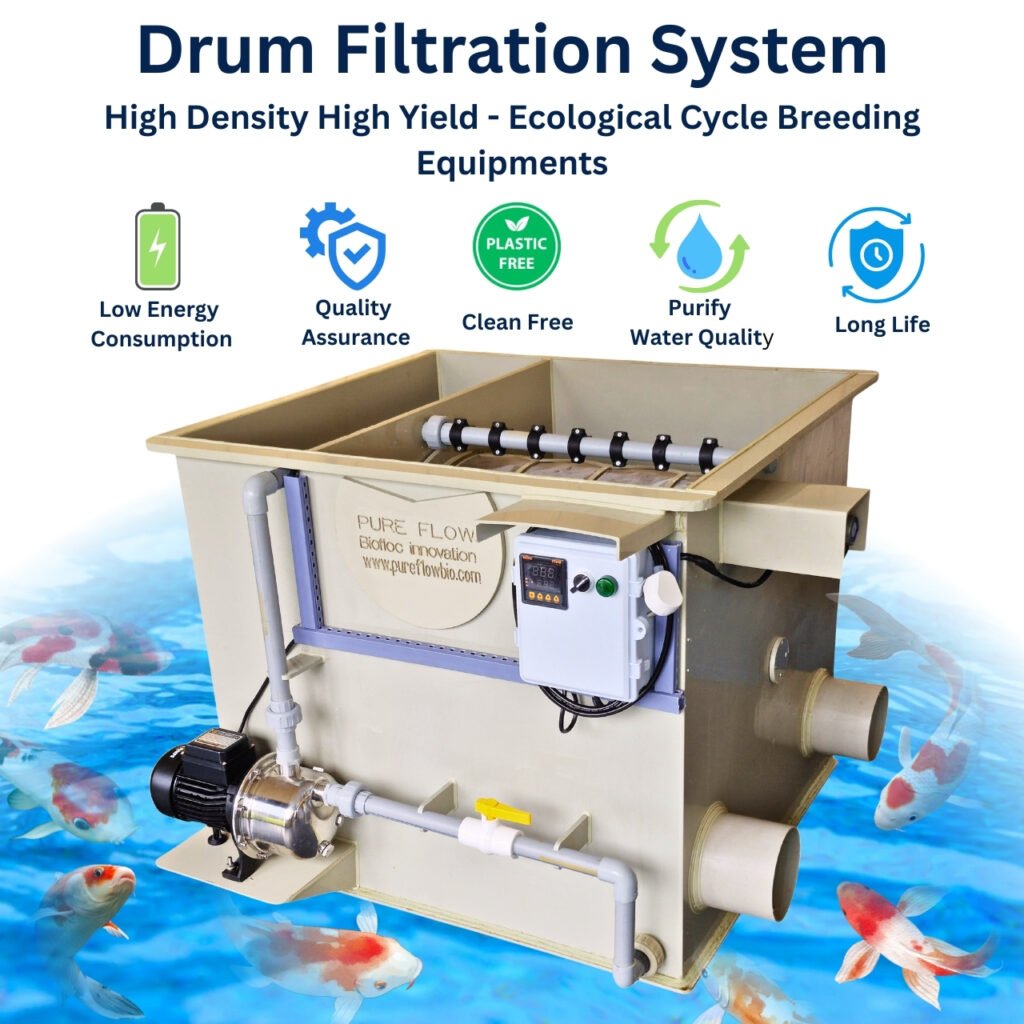
📊 Comparison: Drum Filter vs Bio Filter vs Combi Drum Filter
| Feature | Drum Filter | Bio Filter | Combi Drum Filter |
|---|---|---|---|
| Removes solids | ✅ | ❌ | ✅ |
| Biological filtration | ❌ | ✅ | ✅ |
| Automation | ✅ | ❌ | ✅ |
| Space-saving | ❌ | ❌ | ✅ |
| Maintenance | Low | Medium | Very Low |
| Installation | Moderate | Moderate | Easy (Plug & Play) |
| MODEL | SIZE (mm) |
WATER VOLUME (m³) |
MAX. FLOW (m³/h) |
WATER INLET (mm) (Customized) |
WATER OUTLET (mm) (Customized) |
|---|---|---|---|---|---|
| DRF – 3-6 | 430*330*360 | 3 | 6 | 32 | 50 |
| DRF – 6-10 | 500*450*500 | 6 | 10 | 50 | 63 |
| DRF - 15 | 655*555*590 | 15 | 15 | 50 | 63 |
| DRF - 30 | 655*655*725 | 30 | 30 | 63 | 75 |
| DRF - 50 | 955*855*850 | 50 | 50 | 90 | 110 |
| DRF - 75 | 1150*850*966 | 75 | 75 | 110 | 110 |
| DRF - 100 | 1250*930*1073 | 100 | 100 | 110 | 200 |
| DRF - 150 | 1585*1005*830 | 150 | 150 | 110 | 200 |
| DRF - 200 | 1690*1420*1290 | 200 | 200 | 160 | 200 |