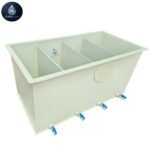
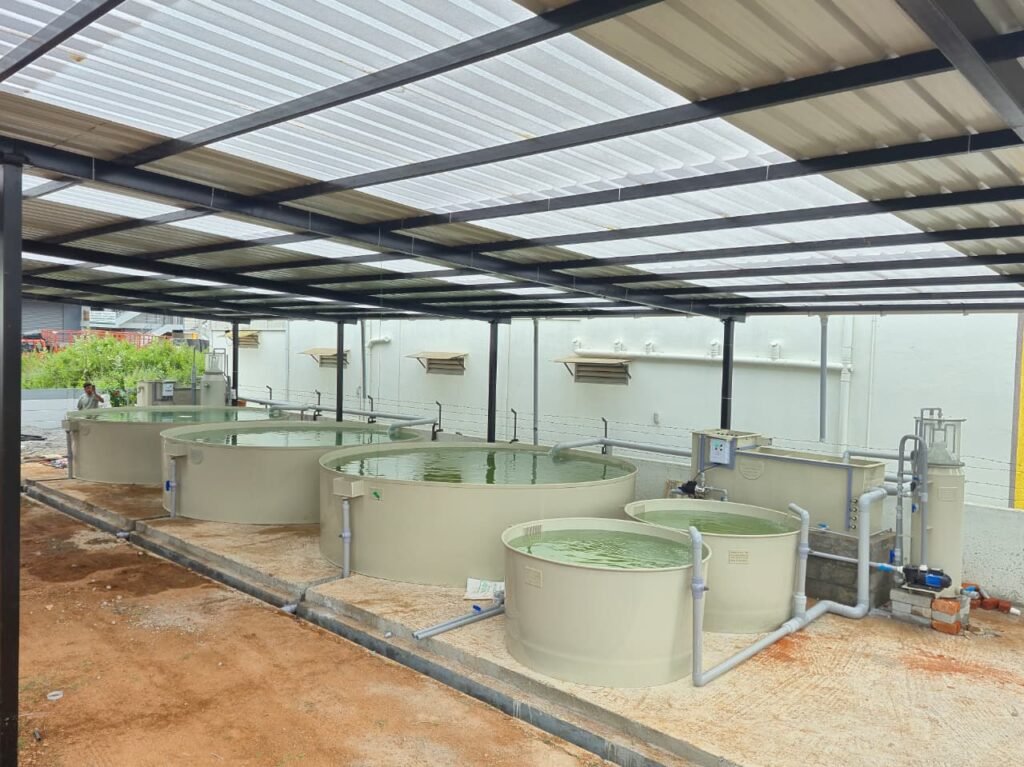
1. Chemical Inertness & Corrosion Resistance
Unlike metal or concrete, polypropylene is completely chemically inert. It will not react with salt (if running a marine or brackish RAS), nor will it degrade when exposed to harsh medications, bio-cure solutions, or ozone treatments. This ensures that absolutely no heavy metals or chemical byproducts leach into the water column.
2. Smooth Surface & Pathogen Control
The interior surface of a PP tank is incredibly smooth and non-porous. This is crucial for hygiene because it prevents pathogenic bacteria and parasites from easily adhering to the tank walls. It ensures that the biological activity stays exactly where you want it—in your dedicated biological filtration stages, like your Bakki showers or moving bed biofilm reactors (MBBR)—rather than forming unwanted, hard-to-clean biofilms on the tank walls.
3. Thermal Insulation
Temperature stability is critical for the nitrifying bacteria in an RAS. Polypropylene has a very low thermal conductivity compared to concrete or metal. This natural insulation helps maintain a stable water temperature, reducing the energy costs required to heat or chill the system, which directly supports a more stable nitrogen cycle.
4. Structural Durability & Weldability
Fiberglass (FRP) tanks can suffer from micro-cracking under stress, which eventually leads to leaks. PP, however, is a thermoplastic. The seams are heat-welded together rather than glued, creating a monolithic structure where the joint is often as strong as the sheet itself. It has a slight flex to it, making it highly resistant to impact and stress fractures.
5. Customization & Modification
Because PP is so easily welded and machined, modifying the tank is incredibly straightforward. If an RAS needs a new bottom drain, a tangential return for better flow dynamics, or an integration with a Combi Rotary Drum Filter, a fabricator can simply cut a hole and extrusion-weld a new PP fitting directly to the tank wall with a perfect seal.