
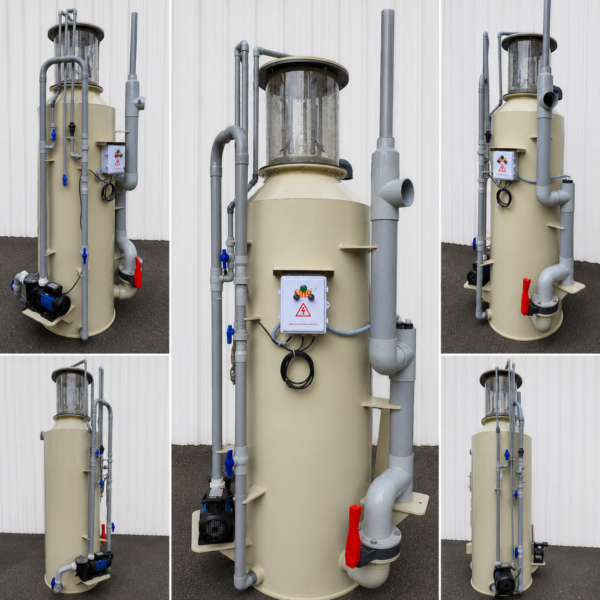
FRESHWATER PROTEIN SKIMMERS
🔍 What They Do:
Freshwater protein skimmers work by creating fine bubbles inside a reaction chamber. Organic waste, proteins, and other dissolved organics adhere to the surface of these bubbles and rise into a collection cup as foam, which is then removed.
⚙️ Do Protein Skimmers Work in Freshwater?
Less Effective Than in Saltwater: Protein skimming is more efficient in saltwater due to its higher surface tension. In freshwater, bubbles don’t form as easily or hold organic material as well.
Specially Designed Skimmers Required: Only high-performance or hybrid skimmers with specific design enhancements (e.g. ozone injection, taller contact columns, venturi or needle-wheel impellers) work moderately well in freshwater.
✅ When to Use a Freshwater Skimmer:
Large public aquariums or heavily stocked ponds
Aquaponics or recirculating aquaculture systems (RAS)
Situations with high protein or organic load
Tannin removal in blackwater tanks
❌ When Not Recommended:
Small home aquariums
Low bioload systems
Tanks with frequent water changes and other filtration
🔧 Alternatives for Freshwater Filtration:
Mechanical (sponges, filter floss)
Biological (bio media, ceramic rings)
Chemical (activated carbon, zeolite)
UV sterilizers (for algae and pathogens)
Bakki showers and moving bed filters (in ponds and RAS)
Luxury & High-End Koi Ponds
Large ornamental Koi ponds are closed loops with massive fish that eat high-protein diets to grow large and vibrant.
-
The Problem: High-protein waste creates a persistent, ugly oily slick on the surface and turns the water a yellowish-brown hue, ruining visibility.
-
The Skimmer’s Job: Large-scale freshwater fractionators strip out the organic tannins and surface proteins. This maximizes light penetration, prevents algae-blooming nutrient spikes, and keeps the water completely crystal-clear.
The Bottom Line: If you are running a high-end Koi pond, a large-scale breeding facility, or dealing with heavy organic sludge, a dedicated freshwater skimmer is highly effective. If you just have a standard household fish tank or a planted aquascape, stick to a high-quality canister filter or chemical filter media like Seachem Purigen.
📌 Summary:
While not commonly used in freshwater, specially designed freshwater protein skimmers can help remove dissolved organics in large or high-waste systems. However, other filtration methods are often more practical and effective for typical freshwater aquariums.
| MODEL | FPS-15, FPS-20, FPS-25, FPS-30, FPS-60, FPS-70, FPS-80, FPS-100, FPS-110, FPS-120, FPS-140, FPS-150, FPS-180 |
|---|


Reviews
There are no reviews yet.